Cutting water and product losses starts with real-time data

Sep 29, 2026
  • food

Walk along almost any food production line, and you’ll see bins and containers with food waste, every few meters. And it’s not just food. Water, energy, and many other valuable resources get lost along the line. Food companies know how much waste hurts. Yet they often can’t pinpoint where in the process it is actually coming from. Belgian start-ups Polysense and Liquisens are attacking that blind spot by catching small deviations in food and water quality before they become waste. (Reading time: 7 minutes)

Different potatoes, identical fries 

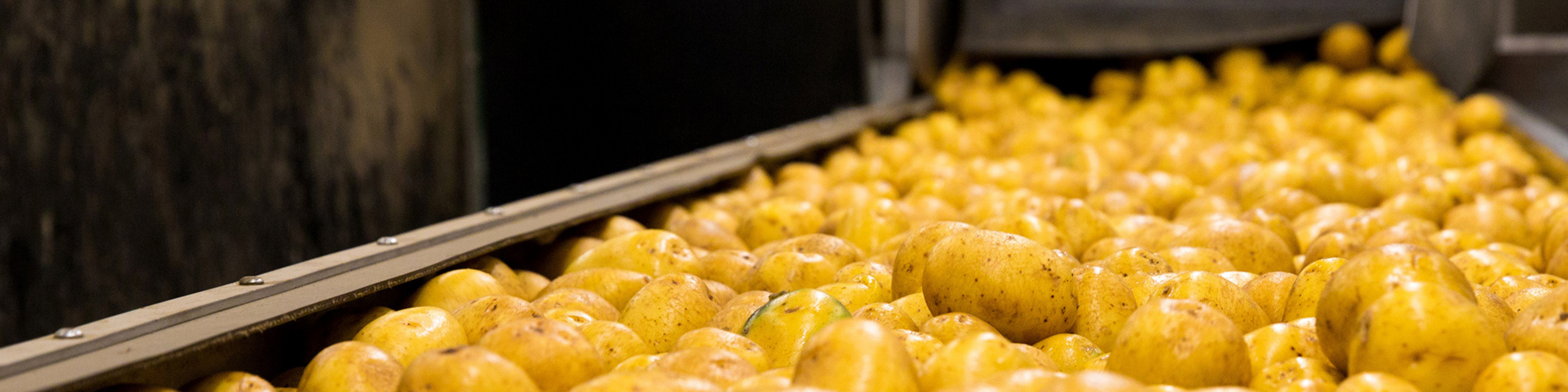
If you ask Yarne De Munck, co-founder and CEO of Polysense, what causes most food waste, he points to the variability of the raw materials: ”Size, moisture, sugar content: you never have the same potato twice. And yet, you can eat fries at a McDonald’s anywhere in the world, and they’re always exactly the same. To be able to deliver that identical size and taste, lots of potatoes that don’t fit the bill, get lost.” 

The reason: the processes that handle the potatoes run on settings that are tuned once and are rarely revisited by whoever’s on the floor that day. When the settings don’t adjust to match, some potatoes end up too big, too small, or off in some other way. Customers, retailers, and foodservice buyers have strict standards, and anything that doesn’t meet these gets rejected.  

The same goes for fruits, veggies, biscuits or any other food product. The quantity lost in the value chain is staggering, and every food manufacturer feels it directly. It is product they’ve paid to grow, and process, and then pay again to dispose of.

Beyond its role as an ingredient, water runs through nearly every step of food production: rinsing, steaming, peeling, and cooling. That are a lot of touchpoints where water can turn into waste or even cause waste elsewhere in the process.
Steven De Schrijver, co-founder and CTO of Liquisens

The hidden waste in water

Steven De Schrijver, co-founder and CTO of Liquisens, points to another raw material where losses show up during food production: water. “Water is less obviously linked to waste, but it is a precious resource for the food industry,” he says. “Beyond its role as an ingredient, water runs through nearly every step of food production: rinsing, steaming, peeling, and cooling. That are a lot of touchpoints where water can turn into waste or even cause waste elsewhere in the process.”  

“Take CIP, the cleaning-in-place cycle that runs between production stages. On paper, it follows a set process: use the exact amount of water, choose the right temperature, add the required chemicals, and respect the timing. But following these steps is no guarantee that the cleaning will actually work. The only way to know for certain is a lab result that takes a day or two to come back. That means that issues are only discovered when it’s too late to prevent them, resulting in rejected or even recalled products.”

Make water quality predictable 

Liquisens monitors water quality and builds predictive models to check, in real time, whether a cleaning cycle actually does its job. Steven explains: “Liquisens Predict draws on process data the plant already has, like temperature, the product that ran before, how long the cycle lasted, pH, conductivity, organic carbon readings, etc. to understand when a CIP cycle is successful for a particular line. Based on those insights, it flags a deviation before it becomes a problem.”  

That’s how Liquisens prevents losses: “Operators are used to building in safety margins in CIP processe. They make sure to use enough water and chemicals and to rinse long enough, just in case. Give them real-time data instead, and that margin can shrink without adding risk. With our tools, they get a signal while there’s still time to act: cleanse again if it’s really needed, hold a batch on purpose instead of out of caution, or move on with confidence. That avoids lost batches, or worse, costly shutdowns, and it means less water and fewer chemicals used overall.” 


Eyes on every potato

Polysense works on the same principle: real-time visibility instead of a delayed result, just aimed at a different part of the line. Where Liquisens reads and predicts what's happening through process data, Polysense relies on visual detection, watching every single item that crosses the line. 

The solution works in two steps. First, the in-line quality control is fully automated: every product gets measured objectively (size, shape, defects, …) and continuously as it moves across the line, instead of an occasional manual check here and there. “Vision systems do the inspection,” Yarne says, “and we process results locally, so that the data is available in real time. To train the system to handle dozens of product types without months of manual labelling, we build much of our training data synthetically. We simulate the production line in a 3D environment to generate the range of variation a real camera would eventually need to recognize.” 

That data then feeds straight into automatic process control: machines and parameters adjust as conditions shift. The result is stable output quality that meets what customers and retailers expect. Waste goes down, and production teams face less pressure to catch every deviation by hand.

One of our customers, a producer of frozen fries, used to check product dimensions through manual sampling. That left a lot of room for inconsistency from one operator to the next. Since switching to continuous, automated inspection, they can catch deviations across their entire range of products quickly and accurately.
Yarne De Munck, co-founder and CEO of Polysense

Not just theory

Polysense’s platform runs across a growing number of food manufacturers. The savings are substantial. “One of our customers, a producer of frozen fries, used to check product dimensions through manual sampling,” Yarne says. “That left a lot of room for inconsistency from one operator to the next. Since switching to continuous, automated inspection, they can catch deviations across their entire range of products quickly and accurately.”   

Steven sees a similar pattern at Liquisens’ customers. Just like Yarne, he’s cautious about sharing ROI and figures, but the potential is real: industry research suggests that the optimization Liquisens works on can realistically cut chemical use by around 24%, while energy costs too drop (-17%).

More than the sum of two

Liquisens and Polysense each solve a real, specific problem in the food production process. "They both work on a niche piece of the puzzle," says Merijn Versyp, lead architect for food at delaware. "Bring them together in our ecosystem, and a food company gets a more holistic view of where loss happens across the entire line.” 

delaware’s part is to act as an orchestrator that connects the technology, people and processes: “We bring the broader vision on IT and OT, and the architecture around it, and we can integrate the technology into a company's existing systems and processes. Just as important is the human side. Operators need to actually trust the data and the tools, and act on it. We help make that shift happen, so things actually change on the floor."

The urgency to start fighting food waste is real, for sustainability and compliance reasons. But the more immediate argument is simpler: waste is eating food manufacturers’ margins. 

Fight Food Waste Week

Every day, raw materials, water, energy, time, and profit disappear from your production process. You know it's happening, but you don't know exactly where, why, or what to do first. 

delaware's Fight Food Waste Week helps you make the invisible visible.

Merijn Versyp

Lead Architect Food

Merijn Versyp works with food manufacturers on their digital transformation journey, from strategy and roadmap definition to tangible improvements on the production floor. His focus lies in helping companies use technology, data, and operational insights to reduce waste, improve efficiency, and prepare their factories for the future.

Connect with Merijn on LinkedIn

Related content